Class Structure: Early Week Observations #2
Seeing the intentionality that goes into the beginning of the school year and structuring the classroom has been very fun to observe. Before any major academic content is introduced, so much work is happening around routines, trust, consistency, and community building. Watching my cooperating teacher build these systems in kindergarten has made me realize how little classroom management is about control. It is about creating an environment where children feel safe, connected, and ready to learn. Many of these practices closely align with the Responsive Classroom approach, especially the emphasis on positive teacher language, interactive modeling, and building community before focusing heavily on academics.
One of the first things I noticed was how much rhythm, repetition, and playfulness are embedded into the daily routines. My mentoring teacher frequently uses rhyming catchphrases to gain students’ attention, such as “Macaroni and cheese, everybody freeze!” or “Ready or not, everybody be on your spot.” There is also a sing song transition phrase for coming to the carpet: “Everybody have a seat on the floor, not on the ceiling, not on the door.” These routines may seem small, but they are developmentally appropriate strategies that help kindergarteners transition smoothly without constant correction or raised voices. The predictability and joy built into these routines reflect Responsive Classroom principles while also connecting to Danielson Domain 2, Creating an Environment of Respect and Rapport, because the classroom culture feels warm, calm, and emotionally safe.
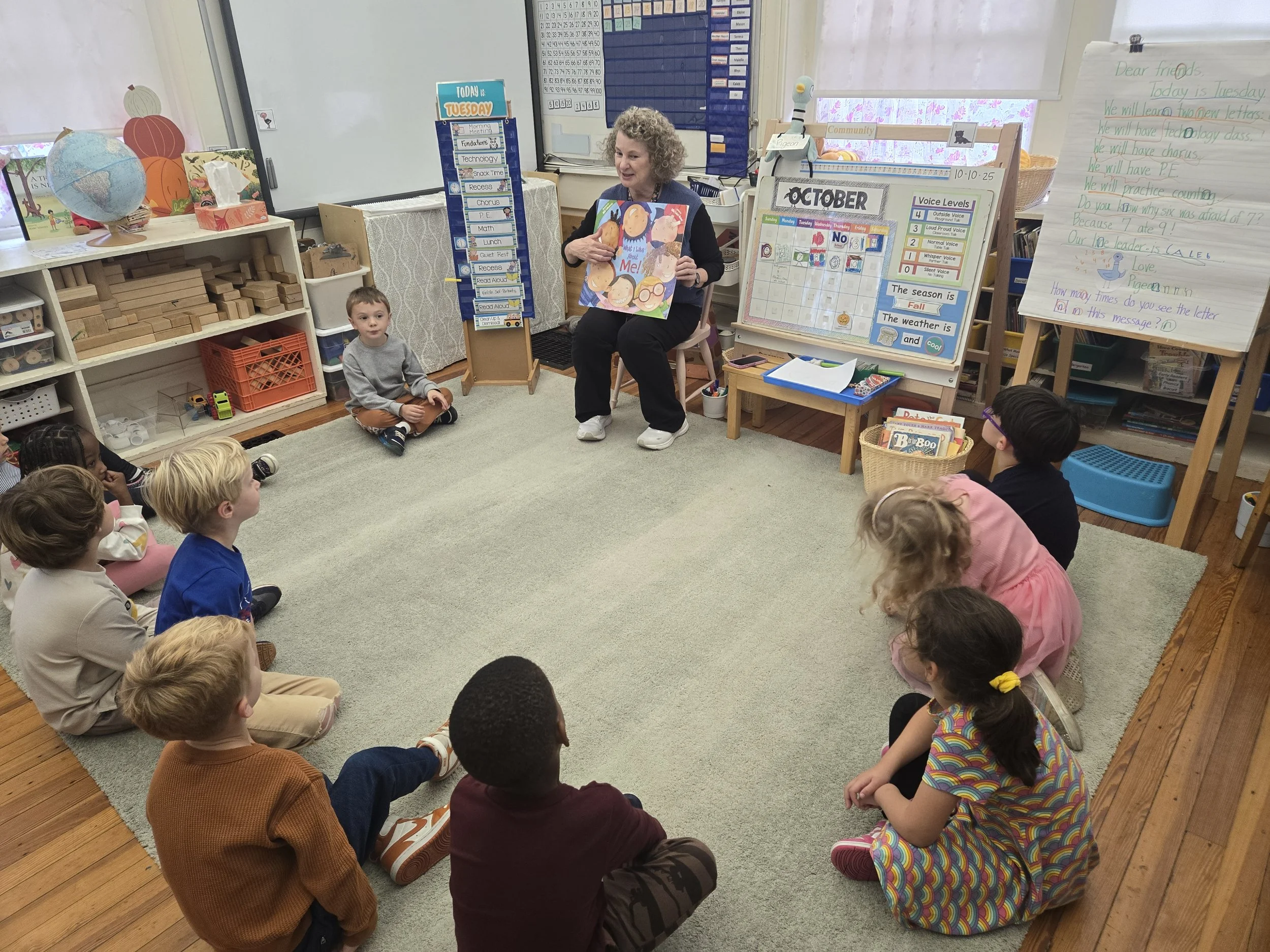
Morning Meeting has become one of the clearest examples to me of how community is intentionally built each day. The students begin with a “Hello Friends” greeting song, followed by a morning message “written” by Mo Willems’ Pigeon (a fan favorite amongst the kindergarteners), and even a brief moment of silence where students practice “holding each other in the light,” reflecting the school’s Quaker values. These routines help students feel recognized and connected before academic learning begins. The class also participates in name games, collaborative discovery play, and uses “ditto” hand signals when students realize they have something in common with each other. These moments encourage students to see themselves as part of a classroom community rather than individuals simply sharing a space. This strongly reflects Responsive Classroom’s focus on belonging and cooperation, as well as Danielson Domain 2’s emphasis on establishing a culture for learning.
I have also noticed how my mentoring teacher handles student struggles and behavioral issues. Instead of public reprimands or punitive responses, she consistently redirects behavior through calm reminders and positive reinforcement. Phrases like “I notice how Ella is following the expected behavior,” or “Thank you Matthew for using your listening ears,” redirect attention toward positive models rather than shaming students who are struggling. Another phrase I hear often is, “Let’s try that again,” which gives students space to correct mistakes without embarrassment. The class also roleplays expected behaviors together during circle time sometimes, practicing routines collaboratively instead of simply being told rules. These approaches align closely with Responsive Classroom teacher language practices and demonstrate Danielson Domain 3, Using Instruction to Support Student Learning, because behavior support is treated as part of teaching rather than separate from it.
One last very meaningful thing I have observed is the intentional effort to build stronger one on one relationships with students who struggle behaviorally or emotionally. Rather than labeling students as “difficult,” my mentoring teacher works to reinforce trust, consistency, and connection. This has reminded me that effective classroom management in kindergarten is deeply rooted in belonging. Students are much more willing to take risks, recover from mistakes, and engage in learning when they feel emotionally secure within the classroom community. Observing these systems in practice has shown me that Responsive Classroom is not simply a set of activities or strategies. It is really a philosophy about treating children with dignity, building predictable and caring environments, and recognizing that relationships are foundational to learning.
